
Welcome to the most comprehensive guide about Tirumala’s history! This sacred temple, nestled in the seven hills of Seshadri, is not just a place of worship – it’s a living testament to thousands of years of faith, devotion, and divine grace. Every year, millions of devotees from across the world climb these holy hills to seek the blessings of Lord Venkateswara. Let’s explore the fascinating story of how this became the world’s most visited religious destination.
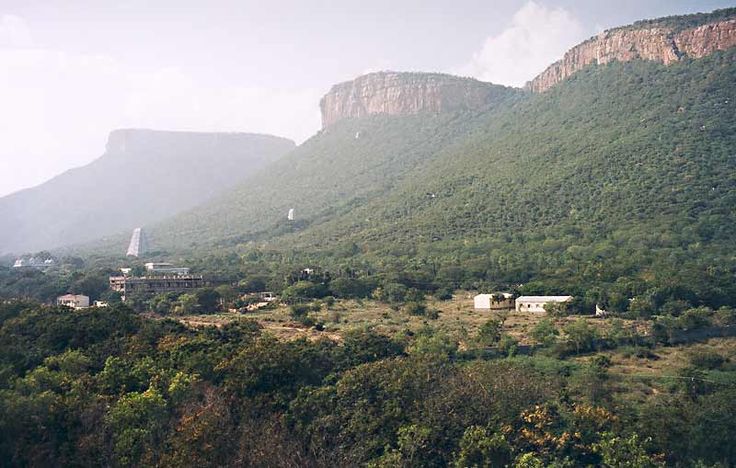
The magnificent Seshadri mountain range where Lord Venkateswara resides
Why Tirumala is the World’s Most Famous Temple
Tirumala Tirupati temple stands on seven hills in Andhra Pradesh, India, dedicated to Lord Venkateswara, a form of Lord Vishnu. What makes this temple truly extraordinary is its popularity. With over 50,000 to 100,000 visitors every single day, Tirumala receives more pilgrims than any other religious place on Earth. That’s more than Vatican City, Mecca during non-Hajj periods, or any other holy site!
Quick Info About Tirumala:
| Feature | Details |
|---|---|
| Location | Seven Hills (Seshadri) in Chittoor District, Andhra Pradesh |
| Daily Visitors | 50,000 to 100,000 pilgrims |
| Temple Age | Over 2,000 years of documented history |
| Annual Income | One of the richest religious institutions globally |
| Temple Area | 2.2 acres (415 feet × 263 feet) |
The Sacred Origin: How Tirumala Was Born
The Story of Lord Varaha and Bhudevi
Long ago, during the Satya Yuga (the first age of the world), a demon named Hiranyaksha caused terrible trouble. He pushed Mother Earth, called Bhudevi, to the bottom of the cosmic ocean. All the gods were worried and prayed to Lord Vishnu for help.
Lord Vishnu then appeared from Lord Brahma’s nose in the magnificent form of Sri Varahadev – a divine boar. With His mighty tusks, He lifted Mother Earth from the ocean depths and brought her back to safety. Bhudevi, who is actually an expansion of Goddess Lakshmi, was overjoyed to be reunited with her Lord.
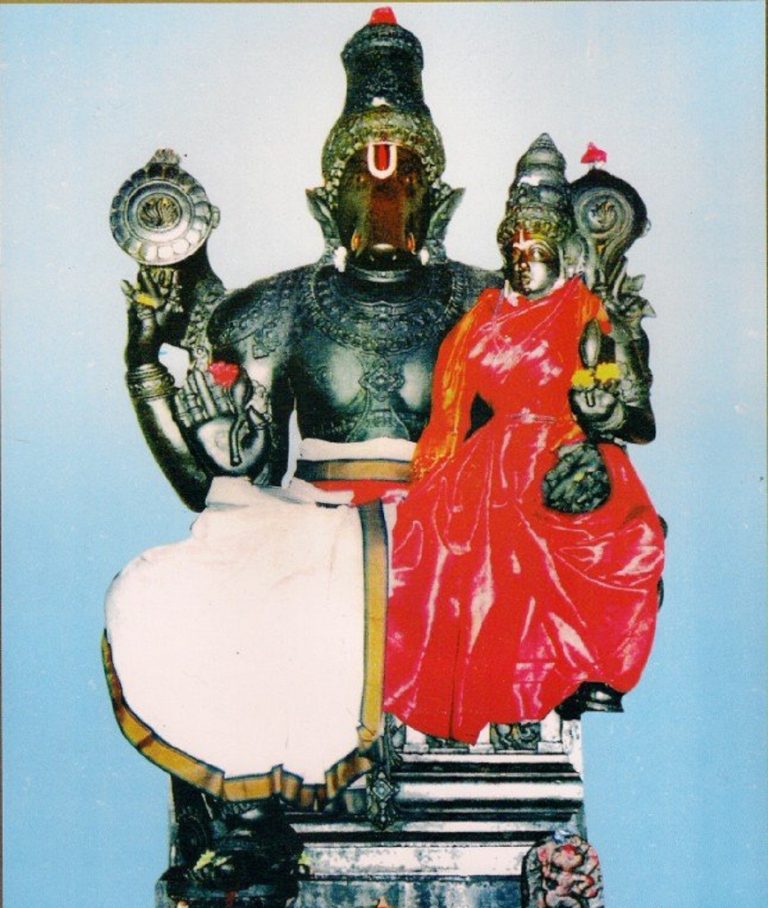
Lord Varaha rescuing Bhudevi from the cosmic ocean
Being deeply devoted to Lord Varaha, Bhudevi requested Him to stay with her on Earth. Lord Varaha agreed and asked Garuda, His divine eagle carrier, to fly to Vaikuntha (the divine realm) and bring down one of His favorite mountains. That sacred mountain is what we know today as Tirumala!
Did You Know? The word “Tirumala” means “Sacred Hill” in Tamil. This mountain was literally brought from Lord Vishnu’s divine realm Vaikuntha to Earth!
The Secret of the Seven Hills: Adisesha’s Manifestation
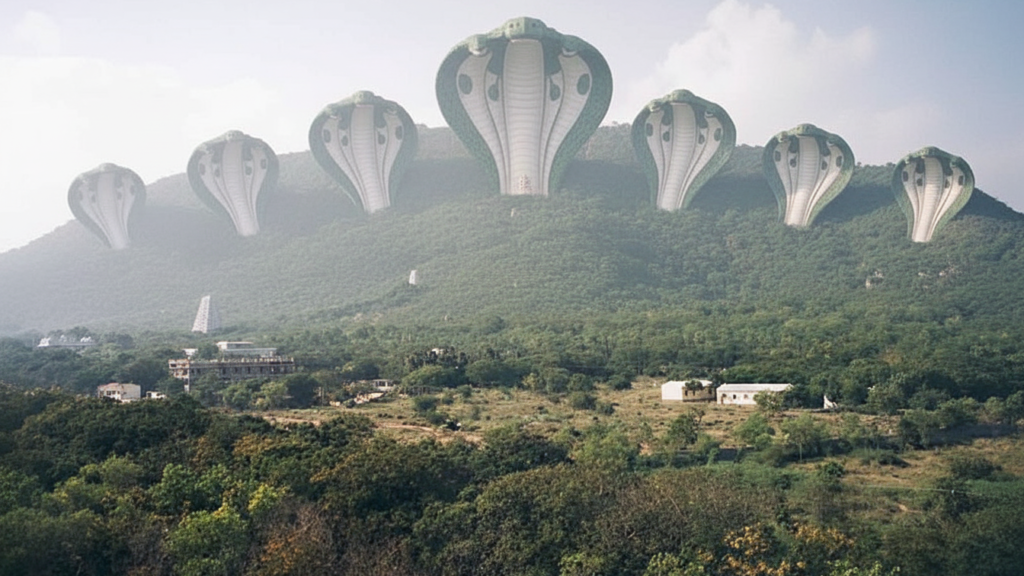
There’s another beautiful story about these hills. Adisesha, the divine thousand-headed serpent who serves as Lord Vishnu’s bed in Vaikuntha, wanted to support the Lord’s presence on Earth. So Adisesha incarnated as these seven hills to provide a perfect resting place for the Lord.
This is why the seven hills are called “Seshadri” – the mountain of Sesha. Each of the seven hills has a special name:
- Seshadri – The first and most important hill
- Neeladri – The blue mountain
- Garudadri – Named after Garuda, the divine eagle
- Anjanadri – Named after Anjana, mother of Hanuman
- Vrushabhadri – The bull mountain
- Narayanadri – Named after Lord Narayana
- Venkatadri – Where the main temple stands today
Each hill represents one of Adisesha’s seven hoods
The Legend of Bhrgu Muni: Finding the Supreme God
One of the most important stories in Tirumala’s history involves the great sage Bhrgu Muni. This story explains why Lord Vishnu is considered the Supreme Personality of Godhead.
The Great Question
Once upon a time, the great sage Narada Muni visited powerful rishis (sages) who were performing a sacred yagna (fire ceremony). Narada asked them an interesting question:
“Among all the gods – Brahma, Vishnu, and Shiva – who is truly the greatest? To whom should we offer the fruits of this yagna?”
The sages had different opinions. Some thought Brahma was the greatest, others believed in Vishnu, and some praised Shiva. After much discussion, they decided that the truly greatest god must be one who is completely free from anger, ego, and all human weaknesses.
They chose Bhrgu Muni, a wise and respected sage, to test all three gods and find out who was truly supreme.
Test #1: Lord Brahma – The Test of Respect
Bhrgu Muni first went to meet his father, Lord Brahma, the creator of the universe. When Brahma saw his son, he was very happy. But Bhrgu Muni purposely ignored his father and showed no respect at all. This was extremely rude according to Indian culture!
Lord Brahma became very angry. His face turned red, and he wanted to punish his disrespectful son. However, somehow he controlled his anger and didn’t say anything.
Result: Bhrgu Muni noticed that his father had failed the test – Brahma was affected by the material quality of anger (raja guna). So Bhrgu Muni quietly left.
Test #2: Lord Shiva – The Test of Tolerance
Next, Bhrgu Muni traveled to Mount Kailash, where Lord Shiva lived with his wife, Goddess Parvati. When Shiva saw his younger brother Bhrgu approaching, he came forward with open arms saying, “Oh Bhrgu! I’m so happy to see you! Welcome to Kailash!”
But Bhrgu Muni stopped him and said insulting words:
“Stay away from me! Don’t touch me! You smell terrible because you cover yourself with ashes from cremation grounds. You wear skulls as jewelry and hang around with ghosts and outcasts. If you touch me, I’ll need to take a hundred baths in the Ganges just to purify myself!”
Lord Shiva about to raise his trident in anger at Mount Kailash
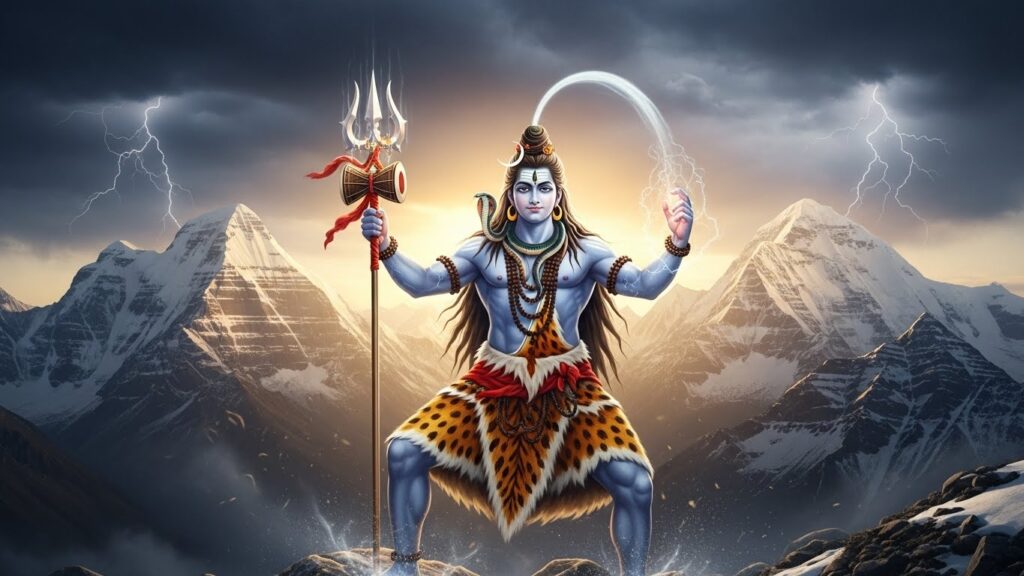
Lord Shiva became furious. He picked up his mighty trident and was about to punish Bhrgu when Parvati quickly intervened. “No, my Lord! Please calm down. He is your brother!” she pleaded.
Lord Shiva listened to his wife and controlled his anger.
Result: Bhrgu Muni noted that even the great Lord Shiva could not remain unaffected by anger, and so he too had failed the test.
Test #3: Lord Vishnu – The Ultimate Test
Finally, Bhrgu Muni went to Swetha Dweepa, Lord Vishnu’s abode within our universe. There he found Lord Vishnu lying on His divine bed, being served by Goddess Lakshmi.
Without any warning or announcement, Bhrgu Muni walked right up to the Lord and kicked Him directly on the chest!
This was the ultimate insult. In Hindu tradition, the chest of Lord Vishnu is where Goddess Lakshmi resides. It’s the most sacred spot. Everyone expected Lord Vishnu to become angry and punish Bhrgu Muni severely.
The moment that proved Lord Vishnu’s supreme compassion
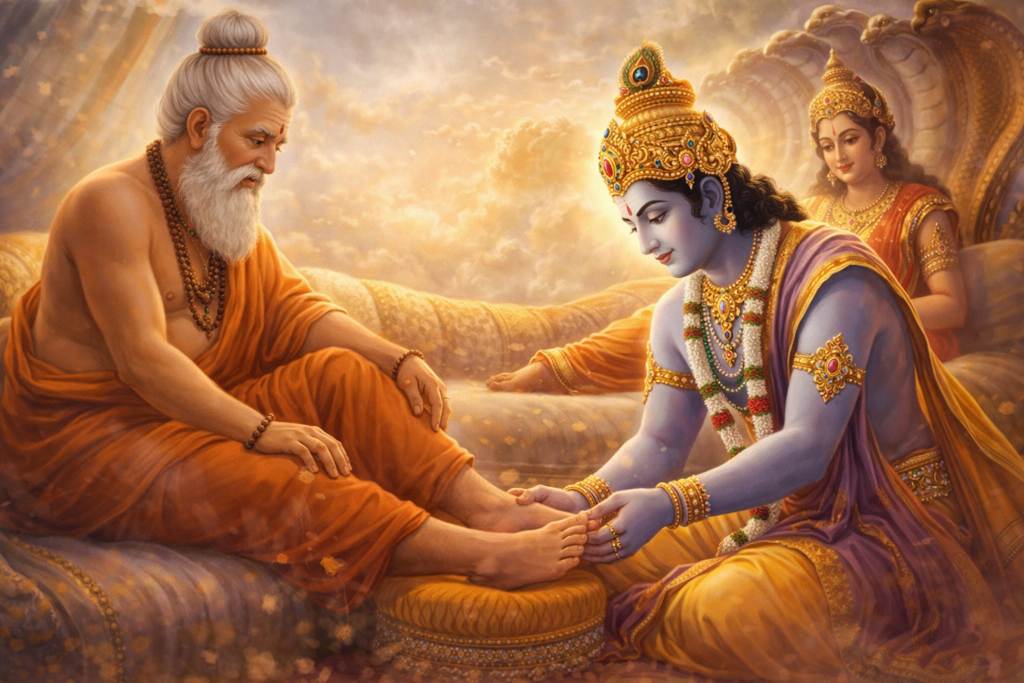
But what happened next shocked everyone. Lord Vishnu stood up, folded His hands respectfully, and said,
“Oh Bhrgu Muni, please forgive Me! I am so sorry that I was lying down when you arrived and didn’t get up to welcome you properly. My chest is so hard, and your lotus feet are so soft. I’m worried that I may have hurt your feet. Please, let Me massage them to make sure you’re not injured.”
Speaking these compassionate words, Lord Vishnu gently began massaging Bhrgu Muni’s feet!
The sage was completely overwhelmed. Tears streamed down his face as he realized he had found the Supreme God – one who is beyond anger, ego, and all material qualities. One who responds to even grave insults with nothing but love and compassion.
Beautiful Fact: According to Sri Caitanya Bhagavatam, after realizing Lord Vishnu’s supreme nature, Bhrgu Muni began dancing in ecstasy! His hair stood on end, tears flowed from his eyes, and he chanted loudly: “Hare Krishna Hare Krishna, Krishna Krishna Hare Hare, Hare Rama Hare Rama, Rama Rama Hare Hare!”
Why Goddess Lakshmi Left Vaikuntha
While everyone was celebrating, there was one person who was not happy – Goddess Lakshmi. Although Lord Vishnu had forgiven Bhrgu Muni with His compassionate heart, Lakshmi Devi, as a devoted wife, could not tolerate seeing her husband insulted.
She said to Lord Narayana:
“You may forgive this Brahmana because that is Your nature. But I witnessed this terrible offense with my own eyes. The sin of watching You being kicked and accepting such disrespect is so great that I cannot continue living here. I must leave Vaikuntha and perform severe penance to wash away this sin.”
This is the key to understanding Tirumala’s origin! According to the sacred texts, Lord Venkateswara came to be on the Venkatadri hills because He came searching for His beloved Lakshmi, who had left Vaikuntha.
This is why devotees say that Lord Venkateswara stands in Tirumala waiting for devotees to bring wealth and offerings – He’s still paying off the debt He took to marry Princess Padmavati (Lakshmi’s incarnation on Earth)!
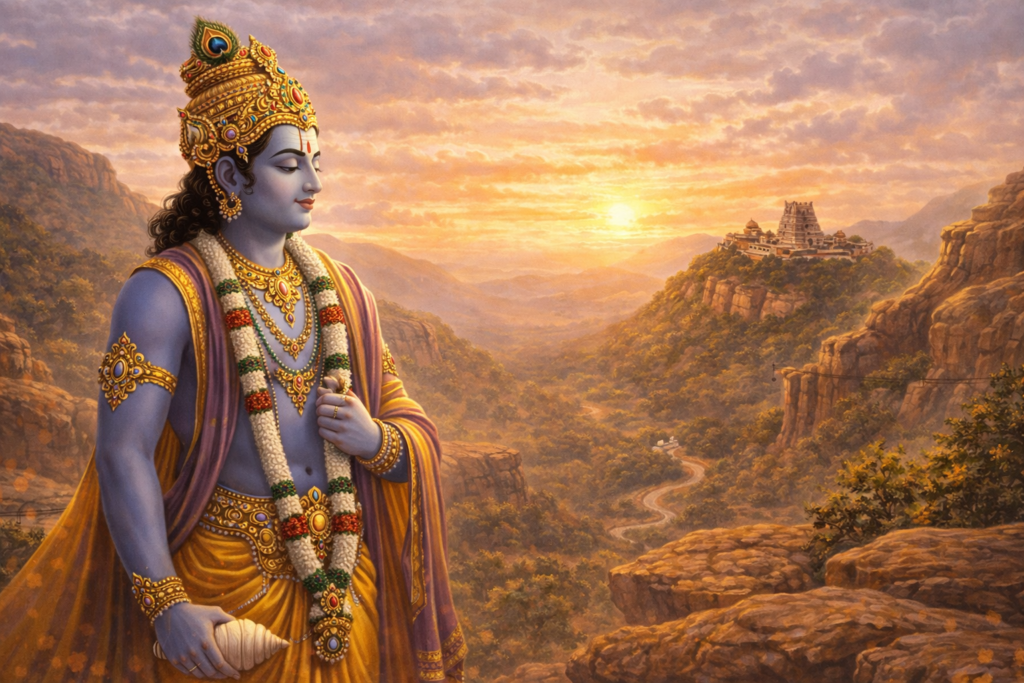
Lord Venkateswara waiting on Venkatadri for His beloved Lakshmi
Historical Timeline: Tirumala Through the Ages
Ancient Times – Before 300 CE
The Tirumala hills have been sacred since time immemorial. Ancient Tamil Sangam literature mentions these holy hills. The earliest references to Lord Venkateswara appear in Tamil texts dating back over 2,000 years. Local tribes and communities have worshipped on these hills for generations beyond recorded history.
6th to 9th Century CE – The Alwar Saints
The twelve Alwar saints, devotees of Lord Vishnu, wrote hundreds of beautiful poems and songs about Tirumala. Their hymns, collected in the Nalayira Divya Prabandham, describe Lord Venkateswara’s beauty and the glory of the seven hills.
These sacred songs are still sung in the temple today. The Alvars spread the glory of Tirumala throughout South India, making it a major pilgrimage destination.
Cultural Impact: The Alwar saints composed over 4,000 verses in praise of various Vishnu temples, with many dedicated specifically to Tirumala. Their poetry transformed Tirumala from a regional shrine into a pan-South Indian pilgrimage center.
9th to 13th Century CE – Early Royal Patronage
The powerful Chola, Pandya, and Pallava dynasties that ruled South India all contributed to Tirumala. They made generous donations of gold, silver, land, and villages. They built mandapams (halls) and improved the temple facilities.
Kings considered it their sacred duty to support the temple. This was when Tirumala began to develop as a major temple complex rather than just a simple shrine.
14th to 16th Century CE – The Golden Age of Vijayanagara
This was the most glorious period in Tirumala’s history. The Vijayanagara Empire, especially under King Sri Krishnadevaraya (1509-1529 CE), transformed Tirumala into a magnificent temple complex.
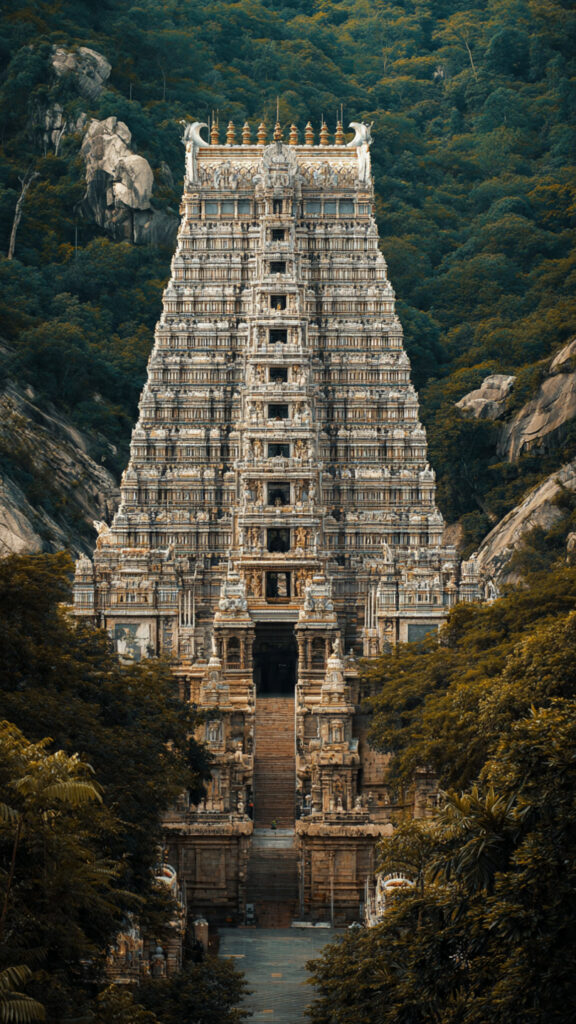
The great emperor who built Tirumala’s main gopuram
What Sri Krishnadevaraya Did for Tirumala:
- Built the temple’s main gopuram (tower) that we see today
- Donated hundreds of kilograms of gold and precious gems
- Established the formal administrative structure
- Created endowments to provide free food for pilgrims
- Wrote poetry in praise of Lord Venkateswara in Telugu and Sanskrit
- Signed royal documents as “Srirangaraya” (servant of the Lord)
The emperor considered himself a humble servant of Lord Venkateswara. His devotion and contributions made Tirumala the wealthy and grand temple it is today.
17th to 19th Century CE – Various Rulers
After the Vijayanagara Empire fell, different rulers controlled Tirumala including:
- The Golconda Sultans
- Mysore kings (including Hyder Ali and Tipu Sultan)
- The Maratha rulers
- Finally the British
Despite changing political control, the temple continued to receive royal support and remained an important pilgrimage center. Each ruling dynasty respected the temple’s sanctity and contributed to its maintenance.
1843 CE – Hatiramji Mutt Management
The administration of Tirumala temple was formally handed over to Sri Deva Dossiji of Hatiramji Mutt at Tirupati. This was an important step in organizing the temple’s management during the British colonial period.
1932-1933 CE – Birth of TTD
The Madras Hindu Religious Endowments Act led to the creation of the Tirumala Tirupati Devasthanams (TTD) as an independent trust. This was a revolutionary moment.
TTD was established as a nonprofit organization specifically to:
- Protect and manage this important religious heritage
- Ensure professional administration
- Maintain transparency in finances
- Expand charitable activities
For the first time, there was a dedicated, professional body to oversee the temple’s operations.
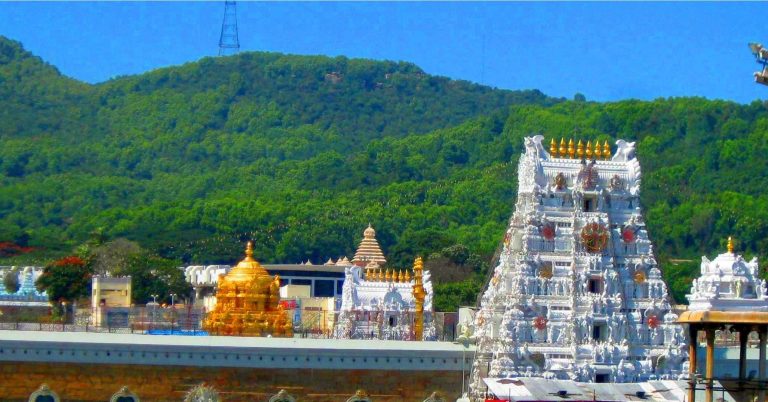
Tirumala Tirupati Devasthanams – Managing faith since 1932
1950s – 2000s – Modern Development
After Indian independence, TTD underwent massive development:
Infrastructure Built:
- Comfortable guest houses and accommodations
- Modern facilities including free food halls
- Drinking water stations throughout the complex
- Medical centers and emergency services
- Better roads and transportation systems
- Queue management systems
- Schools, colleges, and hospitals
2000s – Present Day – Digital Age
TTD embraced modern technology to serve pilgrims better:
- Online booking systems for darshan, accommodations, and sevas
- Mobile apps providing real-time crowd information
- Live darshan streaming for those unable to visit
- CCTV surveillance for pilgrim safety
- Digital payment options alongside traditional Hundi
- Virtual tours of the temple complex
Despite using modern technology, the ancient traditions and rituals are preserved exactly as they have been for centuries!
Why People Keep Coming Back
What makes Tirupati so special that people visit again and again? It’s not just about religion. People say they feel peace and positive energy when they visit. The beautiful surroundings, the ancient traditions, and the feeling of being part of something bigger than themselves – all of this makes Tirupati unforgettable.
Many devotees believe that Lord Venkateswara fulfills wishes and protects his devotees. Whether you believe in miracles or not, there’s no denying the powerful sense of devotion and community you feel at Tirupati.
🌟 Record Breaker!
The Guinness Book of World Records has recognized Tirupati as the most visited place of worship in the world! It beats famous places like St. Peter’s Basilica in Vatican City and the Kaaba in Mecca in terms of daily visitor numbers.
Conclusion: A Timeless Treasure
The history of Tirumala Tirupati is a beautiful story that spans thousands of years. From ancient legends to modern times, this sacred place has remained a beacon of faith, hope, and devotion. Whether you’re interested in history, architecture, culture, or spirituality, Tirupati has something special for everyone.
The temple stands as a reminder of India’s rich heritage and the enduring power of faith. As millions continue to climb those seven sacred hills, they become part of a tradition that connects the past with the present and will continue into the future.
Visiting Tirupati isn’t just about seeing a temple – it’s about experiencing a piece of living history, where ancient traditions meet modern management, where millions of individual prayers create a symphony of devotion, and where the sacred and the everyday come together in a truly unique way.
Planning to Visit? Remember to book your darshan online in advance, especially during festival seasons. Wear modest clothing, be prepared for long waits, and keep an open heart. The journey is as important as the destination!
🙏 Om Namo Venkatesaya 🙏
May Lord Venkateswara bless everyone who reads about his sacred abode!
Tirumala Tirupati history, Lord Venkateswara, Tirupati temple history, Seven Hills, Andhra Pradesh temple, Hindu pilgrimage
